He Downward Slope of the Demand Curve Again Illustrates the Pattern That as Rises
The constabulary of demand states that, other things existence equal,
- More than of a good will be bought the lower its price
- Less of a good will be bought the higher its price
Ceteris paribus means "other things being equal."
What Is Need?
Demand for Goods and Services
Economists use the term demand to refer to the corporeality of some good or service consumers are willing and able to purchase at each price. Demand is based on needs and wants—a consumer may be able to differentiate between a need and a want, simply from an economist'south perspective, they are the same matter. Demand is too based on ability to pay. If y'all tin can't pay for it, you have no effective demand.
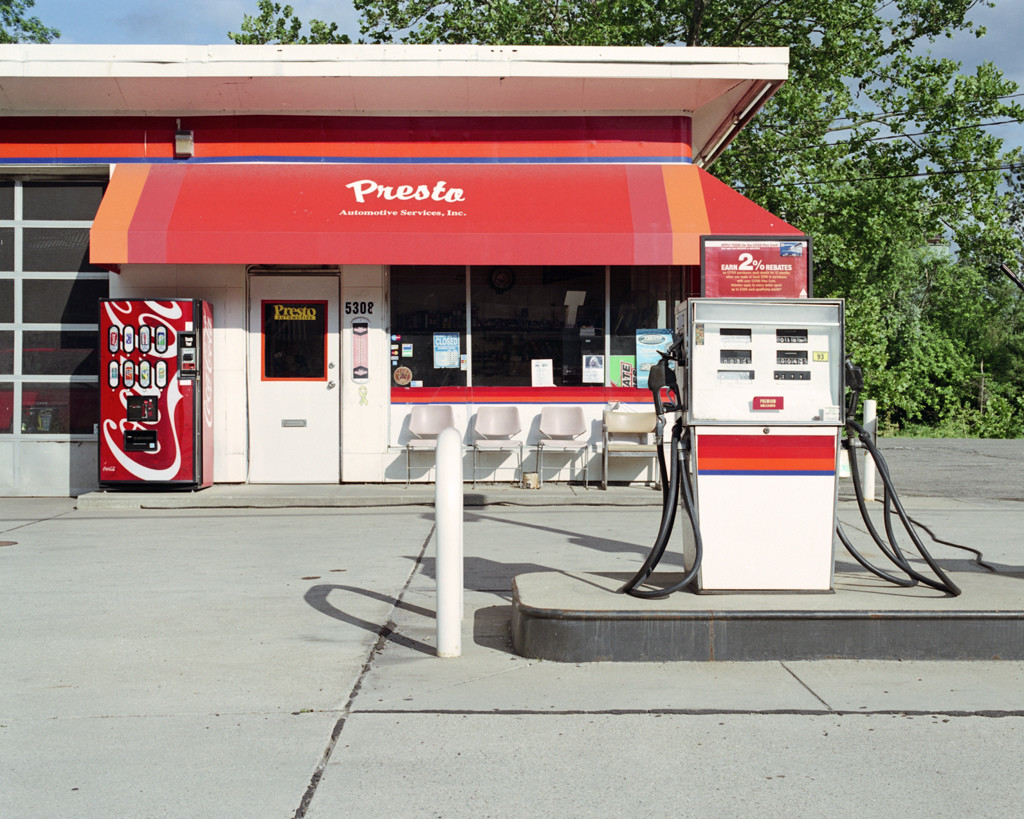
What a buyer pays for a unit of measurement of the specific good or service is called theprice. The full number of units purchased at that toll is chosen the quantity demanded. A rise in the price of a good or service about ever decreases the quantity of that good or service demanded. Conversely, a autumn in toll will increase the quantity demanded. When the price of a gallon of gasoline goes upward, for example, people look for ways to reduce their consumption past combining several errands, commuting past carpool or mass transit, or taking weekend or vacation trips closer to dwelling house. Economists call this inverse relationship between cost and quantity demanded the law of demand. The law of need assumes that all other variables that affect demand are held constant.
An instance from the market for gasoline tin exist shown in the form of a table or a graph. (Refer back to "Reading: Creating and Interpreting Graphs" in module 0 if you need a refresher on graphs.) A tabular array that shows the quantity demanded at each price, such as Table 1, is called a demand schedule. Price in this case is measured in dollars per gallon of gasoline. The quantity demanded is measured in millions of gallons over some time menses (for example, per day or per twelvemonth) and over some geographic area (like a country or a country).
Tabular array 1. Price and Quantity Demanded of Gasoline
| Price (per gallon) | Quantity Demanded (millions of gallons) |
|---|---|
| $one.00 | 800 |
| $1.twenty | 700 |
| $ane.40 | 600 |
| $1.60 | 550 |
| $1.80 | 500 |
| $2.00 | 460 |
| $ii.xx | 420 |
A demand curve shows the relationship between price and quantity demanded on a graph similar Figure i, below, with quantity on the horizontal axis and the toll per gallon on the vertical axis. Note that this is an exception to the normal rule in mathematics that the contained variable (ten) goes on the horizontal centrality and the dependent variable (y) goes on the vertical. Economics is dissimilar from math!
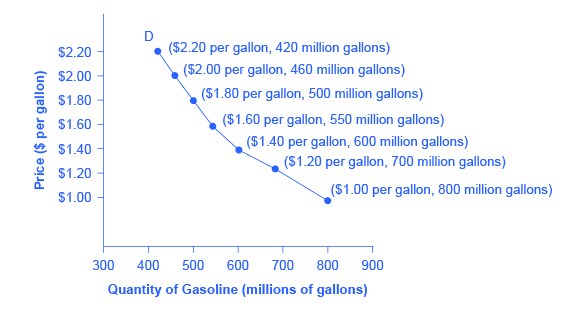
Figure ane. A Demand Curve for Gasoline
The demand schedule (Table 1) shows that as cost rises, quantity demanded decreases, and vice versa. These points tin can so be graphed, and the line connecting them is the need curve (shown by line D in the graph, in a higher place). The downward slope of the need curve over again illustrates the constabulary of demand—the inverse human relationship between prices and quantity demanded.
The demand schedule shown past Table 1 and the demand curve shown by the graph in Figure ane are two means of describing the aforementioned human relationship between price and quantity demanded.
Demand curves will wait somewhat different for each product. They may appear relatively steep or flat, or they may be directly or curved. Most all demand curves share the fundamental similarity that they slope down from left to right. In this style, demand curves embody the law of demand: Every bit the price increases, the quantity demanded decreases, and conversely, as the cost decreases, the quantity demanded increases.
Demand vs. Quantity Demanded
In economical terminology, demand is not the same as quantity demanded. When economists talk about demand, they mean the relationship between a range of prices and the quantities demanded at those prices, as illustrated by a demand curve or a need schedule. When economists talk about quantity demanded, they mean only a certain point on the demand bend, or one quantity on the demand schedule. In brusque, demand refers to the curve and quantity demanded refers to the (specific) indicate on the curve.
Modify in Need vs. Change in Quantity Demanded
A change in cost does not move the demand curve. Information technology only shows a difference in the quantity demanded.
The need curve volition move left or right when there is an underlying change in need at all prices.
Factors Affecting Demand

Introduction
We defined demand as the amount of some product that a consumer is willing and able to purchase at each price. This suggests at least two factors, in addition to price, that affect demand. "Willingness to purchase" suggests a desire to purchase, and it depends on what economists call tastes and preferences. If you neither need nor want something, y'all won't be willing to buy it. "Ability to buy" suggests that income is of import. Professors are unremarkably able to afford better housing and transportation than students, because they have more income. The prices of related goods can too affect demand. If you need a new automobile, for example, the price of a Honda may affect your need for a Ford. Finally, the size or composition of the population can affect demand. The more children a family unit has, the greater their demand for vesture. The more than driving-age children a family unit has, the greater their need for car insurance and the less for diapers and babe formula.
These factors affair both for demand by an individual and demand by the market every bit a whole. Exactly how do these diverse factors bear on need, and how do nosotros bear witness the effects graphically? To answer those questions, nosotros need the ceteris paribus assumption.
The Ceteris Paribus Supposition
Aneed curve or a supply curve (which we'll embrace later on in this module) is a relationship between two, and only two, variables: quantity on the horizontal centrality and toll on the vertical axis. The supposition backside a demand bend or a supply curve is that no relevant economic factors, other than the product's cost, are changing. Economists call this assumption ceteris paribus , a Latin phrase significant "other things beingness equal." Any given demand or supply curve is based on the ceteris paribus assumption that all else is held equal. (Y'all'll recall that economists apply the ceteris paribus assumption to simplify the focus of analysis.) Therefore, a demand curve or a supply curve is a relationship between two, and only two, variables when all other variables are held equal. If all else is not held equal, then the laws of supply and demand will non necessarily hold.
Ceteris paribus is typically applied when we look at how changes in toll affect demand or supply, but ceteris paribus tin too exist applied more than mostly. In the real earth, demand and supply depend on more factors than just price. For example, a consumer's demand depends on income, and a producer's supply depends on the cost of producing the product. How can nosotros analyze the effect on demand or supply if multiple factors are changing at the aforementioned time—say price rises and income falls? The answer is that we examine the changes one at a time, and assume that the other factors are held constant.
For example, nosotros can say that an increase in the toll reduces the amount consumers volition buy (assuming income, and annihilation else that affects demand, is unchanged). Additionally, a subtract in income reduces the amount consumers can afford to buy (assuming price, and anything else that affects demand, is unchanged). This is what the ceteris paribus assumption really means. In this particular example, after we analyze each cistron separately, we can combine the results. The amount consumers buy falls for two reasons: first because of the college price and 2nd because of the lower income.
The Outcome of Income on Demand
Let's use income every bit an example of how factors other than price touch on demand. Figure 1 shows the initial demand for automobiles as D0. At indicate Q, for instance, if the price is $20,000 per automobile, the quantity of cars demanded is 18 million. D0 also shows how the quantity of cars demanded would change as a issue of a college or lower price. For example, if the cost of a car rose to $22,000, the quantity demanded would decrease to 17 million, at point R.
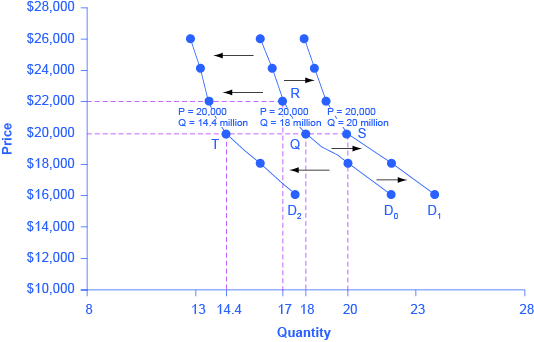
Figure 1. Shifts in Demand: A Car Case
The original demand curve D0, like every demand curve, is based on the ceteris paribus assumption that no other economically relevant factors change. Now imagine that the economy expands in a manner that raises the incomes of many people, making cars more affordable. How will this affect demand? How can we show this graphically?
Return to Effigy ane. The price of cars is even so $twenty,000, merely with higher incomes, the quantity demanded has now increased to 20 one thousand thousand cars, shown at betoken S. As a outcome of the college income levels, the demand curve shifts to the correct to the new demand curve D1, indicating an increase in demand. Table 1, beneath, shows clearly that this increased demand would occur at every cost, not just the original one.
| Price | Decrease to D2 | Original Quantity Demanded D0 | Increase to Di |
|---|---|---|---|
| $16,000 | 17.half dozen one thousand thousand | 22.0 million | 24.0 meg |
| $18,000 | 16.0 1000000 | 20.0 million | 22.0 million |
| $20,000 | 14.iv million | 18.0 million | xx.0 million |
| $22,000 | 13.half-dozen million | 17.0 million | nineteen.0 million |
| $24,000 | 13.2 meg | sixteen.5 meg | eighteen.5 million |
| $26,000 | 12.8 million | 16.0 million | 18.0 million |
Now, imagine that the economy slows downwards so that many people lose their jobs or piece of work fewer hours, reducing their incomes. In this case, the decrease in income would lead to a lower quantity of cars demanded at every given cost, and the original demand curve D0 would shift left to D2. The shift from D0 to D2 represents such a decrease in need: At any given price level, the quantity demanded is now lower. In this example, a cost of $20,000 means xviii 1000000 cars sold forth the original demand curve, merely only 14.iv one thousand thousand sold after need fell.
When a need curve shifts, information technology does not hateful that the quantity demanded by every individual buyer changes past the same amount. In this example, non everyone would have higher or lower income and not everyone would purchase or non buy an boosted car. Instead, a shift in a demand bend captures a design for the marketplace as a whole: Increased demand means that at every given price, the quantity demanded is higher, so that the demand curve shifts to the right from D0 to D1. And, decreased demand means that at every given toll, the quantity demanded is lower, so that the demand bend shifts to the left from D0 to D2.
We merely argued that higher income causes greater need at every price. This is true for most goods and services. For some—luxury cars, vacations in Europe, and fine jewelry—the effect of a rise in income can be especially pronounced. A product whose demand rises when income rises, and vice versa, is called a normal good. A few exceptions to this pattern do exist, however. Equally incomes rise, many people will buy fewer generic-brand groceries and more than name-make groceries. They are less probable to buy used cars and more than probable to purchase new cars. They will be less likely to rent an apartment and more likely to own a dwelling house, and and then on. A production whose demand falls when income rises, and vice versa, is chosen an inferior practiced. In other words, when income increases, the demand bend shifts to the left.
Other Factors That Shift Demand Curves
Income is not the only cistron that causes a shift in demand. Other things that change demand include tastes and preferences, the composition or size of the population, the prices of related appurtenances, and even expectations. A change in whatever 1 of the underlying factors that determine what quantity people are willing to buy at a given price volition cause a shift in need. Graphically, the new demand bend lies either to the right (an increase) or to the left (a decrease) of the original demand bend. Allow's look at these factors.
Changing Tastes or Preferences

From 1980 to 2012, the per-person consumption of chicken past Americans rose from 33 pounds per year to 81 pounds per year, and consumption of beef fell from 77 pounds per year to 57 pounds per year, according to the U.S. Department of Agriculture (USDA). Changes like these are largely due to shifts in sense of taste, which change the quantity of a good demanded at every price: That is, they shift the demand curve for that skillful—rightward for chicken and leftward for beef.
Changes in the Composition of the Population
The proportion of elderly citizens in the United states population is rising. Information technology rose from 9.8 percent in 1970 to 12.6 pct in 2000 and volition exist a projected (by the U.S. Census Agency) 20 percent of the population by 2030. A society with relatively more than children, like the United states in the 1960s, volition have greater demand for goods and services like tricycles and twenty-four hours care facilities. A society with relatively more elderly persons, as the United states is projected to take past 2030, has a higher demand for nursing homes and hearing aids. Similarly, changes in the size of the population tin affect the demand for housing and many other goods. Each of these changes in demand will be shown as a shift in the demand curve.
Changes in the Prices of Related Goods
The demand for a product can also be afflicted by changes in the prices of related goods such as substitutes or complements. Asubstitute is a good or service that tin be used in identify of another practiced or service. As electronic books, like this one, become more bachelor, y'all would expect to run across a decrease in demand for traditional printed books. A lower price for a substitute decreases need for the other product. For example, in recent years as the price of tablet computers has fallen, the quantity demanded has increased (considering of the police force of demand). Since people are purchasing tablets, there has been a subtract in need for laptops, which can exist shown graphically equally a leftward shift in the need curve for laptops. A higher cost for a substitute skilful has the reverse effect.
Other goods are complements for each other, meaning that the appurtenances are often used together, because consumption of one good tends to raise consumption of the other. Examples include breakfast cereal and milk; notebooks and pens or pencils, golf balls and golf clubs; gasoline and sport utility vehicles; and the five-way combination of salary, lettuce, tomato, mayonnaise, and bread. If the price of golf clubs rises, since the quantity of golf clubs demanded falls (considering of the law of need), need for a complement good like golf balls decreases, too. Similarly, a college toll for skis would shift the demand curve for a complement adept similar ski resort trips to the left, while a lower price for a complement has the reverse effect.

Changes in Expectations About Future Prices or Other Factors That Affect Demand
While it is clear that the price of a good affects the quantity demanded, information technology is also true that expectations virtually the time to come price (or expectations about tastes and preferences, income, and so on) can affect demand. For example, if people hear that a hurricane is coming, they may rush to the shop to buy flashlight batteries and bottled water. If people learn that the cost of a good like coffee is likely to rise in the time to come, they may head for the shop to stock up on coffee now. These changes in demand are shown every bit shifts in the bend. Therefore, ashift in demand happens when a change in some economical cistron (other than the current cost) causes a different quantity to exist demanded at every price.
Worked Instance: Shift in Demand

Shift in Need Due to Income Increase
A shift in need ways that at any price (and at every price), the quantity demanded will be different than it was earlier. Following is a graphic analogy of a shift in need due to an income increase.
Pace 1. Describe the graph of a need curve for a normal good like pizza. Option a price (like P0). Place the corresponding Q0. An example is shown in Effigy 1.
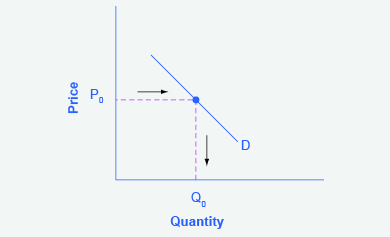
Effigy 1. Need Bend.A demand curve tin be used to identify how much consumers would purchase at any given price.
Pace 2. Suppose income increases. Every bit a effect of the modify, are consumers going to buy more or less pizza? The answer is more. Draw a dotted horizontal line from the called price, through the original quantity demanded, to the new signal with the new Qone. Draw a dotted vertical line down to the horizontal axis and label the new Qi. An case is provided in Figure 2.
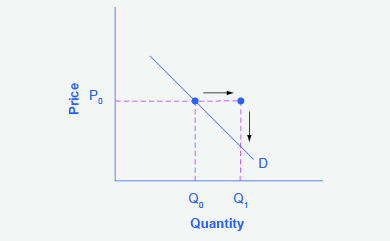
Figure 2. Demand Curve with Income Increase. With an increase in income, consumers will purchase larger quantities, pushing need to the right.
Step 3. Now, shift the curve through the new signal. You will run into that an increment in income causes an up (or rightward) shift in the demand bend, so that at any price, the quantities demanded will be college, as shown in Figure iii.
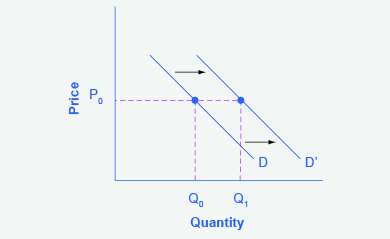
Figure 3. Demand Curve Shifted Right. With an increase in income, consumers will buy larger quantities, pushing demand to the right, and causing the demand curve to shift right.
Summary of Factors That Alter Need
6 factors that tin can shift demand curves are summarized in Figure 1, below. The direction of the arrows indicates whether the demand curve shifts represent an increase in need or a decrease in demand. Detect that a change in the price of the good or service itself is not listed amid the factors that can shift a demand curve. A change in the price of a good or service causes a motion forth a specific demand curve, and it typically leads to some modify in the quantity demanded, only it does not shift the need bend.

Figure i. Factors That Shift Demand Curves (a) A list of factors that can cause an increase in demand from D0 to D1. (b) The aforementioned factors, if their management is reversed, can crusade a subtract in demand from D0 to D1.
Endeavor Information technology: Demand for Nutrient Trucks
Play the simulation beneath multiple times to see how different choices lead to unlike outcomes. All simulations let unlimited attempts so that you can gain experience applying the concepts.
Check Your Understanding
Answer the question(s) below to see how well you understand the topics covered above. This short quiz does not count toward your grade in the class, and yous tin can retake it an unlimited number of times.
Use this quiz to cheque your understanding and make up one's mind whether to (i) written report the previous section further or (2) move on to the next section.
Source: https://courses.lumenlearning.com/suny-hccc-introbusiness/chapter/the-law-of-demand/
0 Response to "He Downward Slope of the Demand Curve Again Illustrates the Pattern That as Rises"
Post a Comment